Sign up today and join our mailing list to receive the latest news, project updates, event invitations, and insights from the PRIMARY project.
What Finnish farmers actually think about grass biorefinery — and why it matters for the project
Aug 26, 2026
If you want to know whether a new agricultural innovation will actually work, there is a simple test: ask farmers early and listen carefully to how they see it. That has been a guiding principle in the PRIMARY project, where farmers were brought into the conversation from the start through national workshops in Finland and Greece.
The reason is straightforward. Researchers and farmers often look at the same concept from different angles. What looks promising in a lab or model can feel unrealistic, risky or irrelevant in the field. By creating space for discussion from the start, the project is not just sharing ideas with farmers, it is stress-testing them and developing solutions that work in practice.
Early farmer engagement as a reality check
In Finland, PRIMARY organised two national farmers’ workshops on grass-based biomass valorisation in spring 2026. One in Salo, in southwest Finland, and another in Jyväskylä, in Central Finland. The workshops introduced the project and its objectives while gathering valuable farmer feedback. Across both workshops, one thing became clear very quickly: farmers are interested. In fact, highly interested.
Grass-based biorefinery concepts — turning grass into feed, food ingredients or bio-based materials — sparked immediate engagement, especially when framed as a potential new income stream for primary production. Farmers clearly see value in finding additional uses and better ways to valorise resources such as grass biomass.
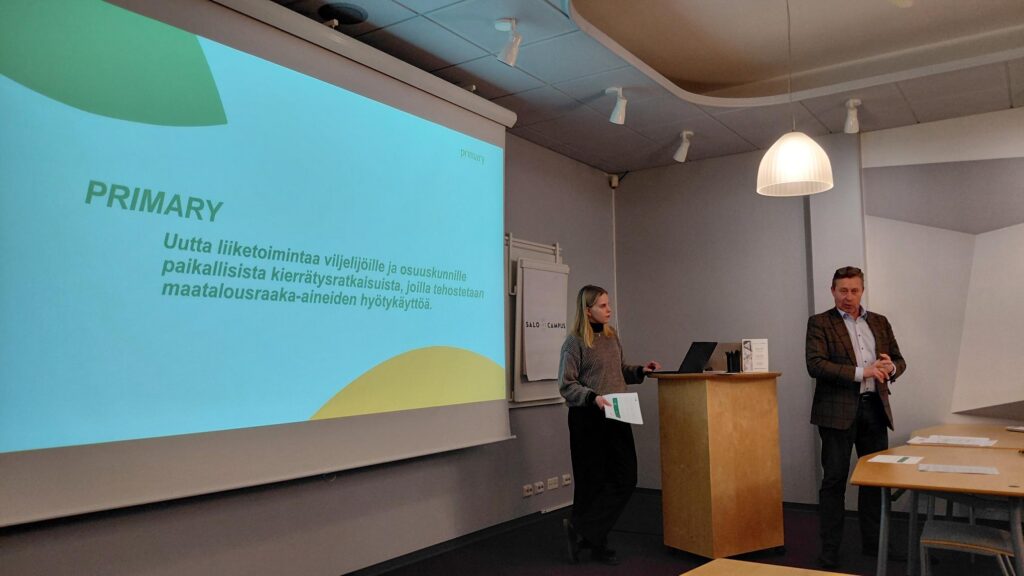
National workshop in Salo, February 10, 2026. Credit: PRIMARY
From interest to practical questions
From the project partners’ perspective, one of the most notable observations was how quickly discussions moved from the concept level to operational detail. Farmers did not stay at the level of “this is interesting”; they immediately started considering how the solutions could be turned into working value chains. The discussions combined research ideas with farmers’ hands-on knowledge and focused on practical questions, such as how grass could be processed locally to avoid transporting water and what harvesting chain would actually work in Finnish conditions.
Logistics, in particular, came up repeatedly as a real bottleneck. In regions such as Central Finland, where field density is low, transporting biomass can be challenging and requires efficient solutions. This grounded questioning is exactly why the goal was to involve farmers early on, even if it can complicate the narrative.
What did farmers connect with immediately?
Some ideas landed right away. Using different types of biomass for different purposes made sense to farmers. Grass was seen as a natural fit for biorefinery processes, while straw and other dry materials were considered better suited for material uses due to their stability and easier handling. Existing systems also provided a bridge. Silage production, already widely used on farms, was seen as a potential foundation for new value chains. The idea that current practices could be adapted rather than replaced lowered the barrier to engagement.
There was also genuine interest in broader benefits such as soil health, reduced fertilizer needs and improved nutrient cycling, as long as biomass removal was balanced. When the concept aligned with existing practices and long-term farm resilience, it resonated.
On the other hand, uncertainty around profitability remained the single biggest barrier. Farmers repeatedly pointed out during the discussions that without clearer calculations on yields, costs and returns, it is not realistic to expect investments in new machinery or processes. They also highlighted the importance of reliable buyers, predictable pricing, functioning logistics and clear risk-sharing arrangements across the value chain.
So, does the project reflect what farmers actually need?
The honest answer is yes, but not automatically. The workshops showed strong alignment on direction: farmers are open to new biomass-based value chains and see real potential and benefits in them.
The value of early farmer engagement is that practical implementation challenges and opportunities are being identified from the outset, helping shape the project’s next steps and future development work.
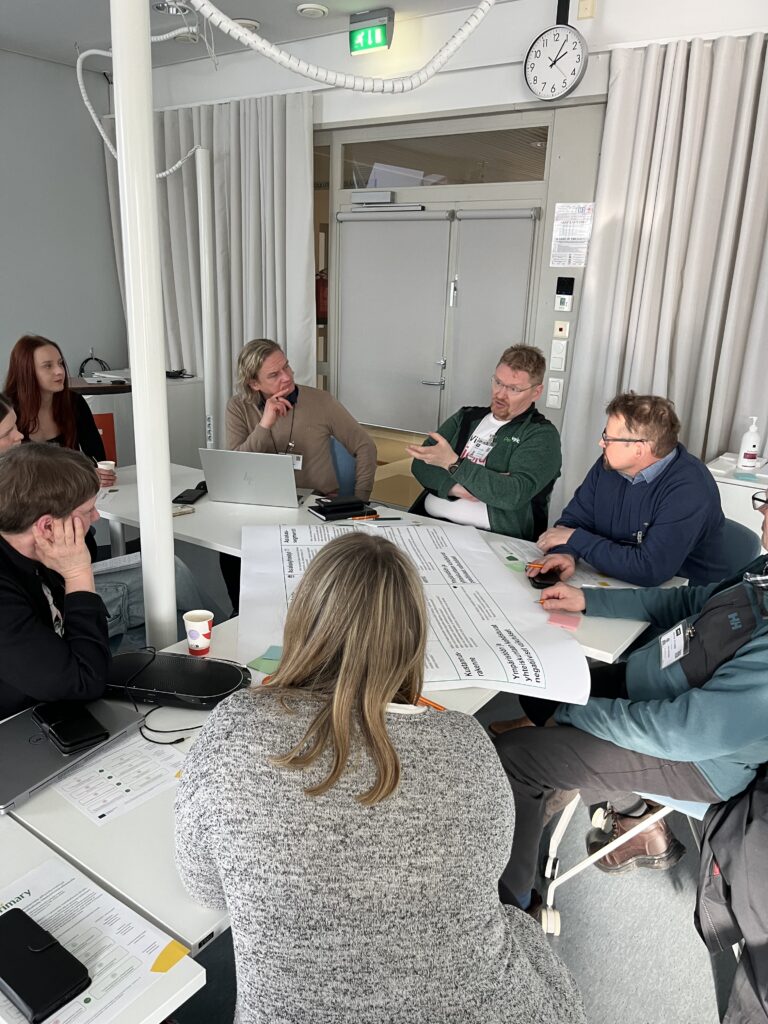
National workshop in Jyväskylä, March 11, 2026. Credit: Helka Hypen
For farmers, this early engagement signals that their realities are being taken into account. For researchers, it helps bring the solutions closer to real-world application. Success is not defined by technical feasibility alone, but by whether the system works on real farms, under real conditions. From MTK’s perspective, active farmer engagement is exactly where value is created. The conversation also continues beyond the workshops, for example at farmer-facing events such as fairs, where discussions can reach a broader audience in a more informal setting.
What happens next?
The project and farmer engagement are still at an early stage. The start is promising, but continued work is needed for PRIMARY to unlock its full potential and improve circular economy-based solutions in practice.
One key takeaway from the first workshops is not that the concept is easy, but that it is worth pursuing in the right way. Farmers are not saying “no”. They are saying: “show us how this works”. That is a constructive starting point for continuing PRIMARY’s work and developing solutions that are not only promising on paper, but also practical and credible on farms.
Author: Helka Hypen, MTK
* Hero image by Anette Ahlqvist at the Kalajoki Farmari fair June 26, 2026