Sign up today and join our mailing list to receive the latest news, project updates, event invitations, and insights from the PRIMARY project.
Unlocking cotton residues: insights from PRIMARY’s field trials in Greece
Dec 15, 2025
Greek field trial in Karditsa, Central Greece, marks a major step in PRIMARY’s mission to demonstrate scalable, community-driven pathways for valorising underused agricultural residues. This past autumn, the Greek partners (CERTH, NEA ENOSI and ESEK) focused on cotton residues, one of the country’s most abundant yet underutilised biomass resources. Their goal: to test practical harvesting methods and assess the potential of cotton stalks for downstream applications such as solid biofuels, gasification and biochar production, soil improvement and construction materials. The trial offered valuable insights into how cooperatives and local communities can integrate sustainable practices that benefit both farmers and the regional bioeconomy.
Why cotton residues matter
Cotton is one of Greece’s most significant crops, yet its post-harvest residues typically remain unused and often left to decompose or burned in the field. PRIMARY aims to convert this overlooked biomass into a valuable resource that supports circular, rural economies. The field trial set out to compare two harvesting methods – a forage harvester and a baling system – to identify the most efficient, scalable and farmer-friendly approach for mobilising cotton residues. Evaluating the technical, operational and economic performance of both pathways is crucial for designing a value chain that can be replicated across cotton-producing regions.
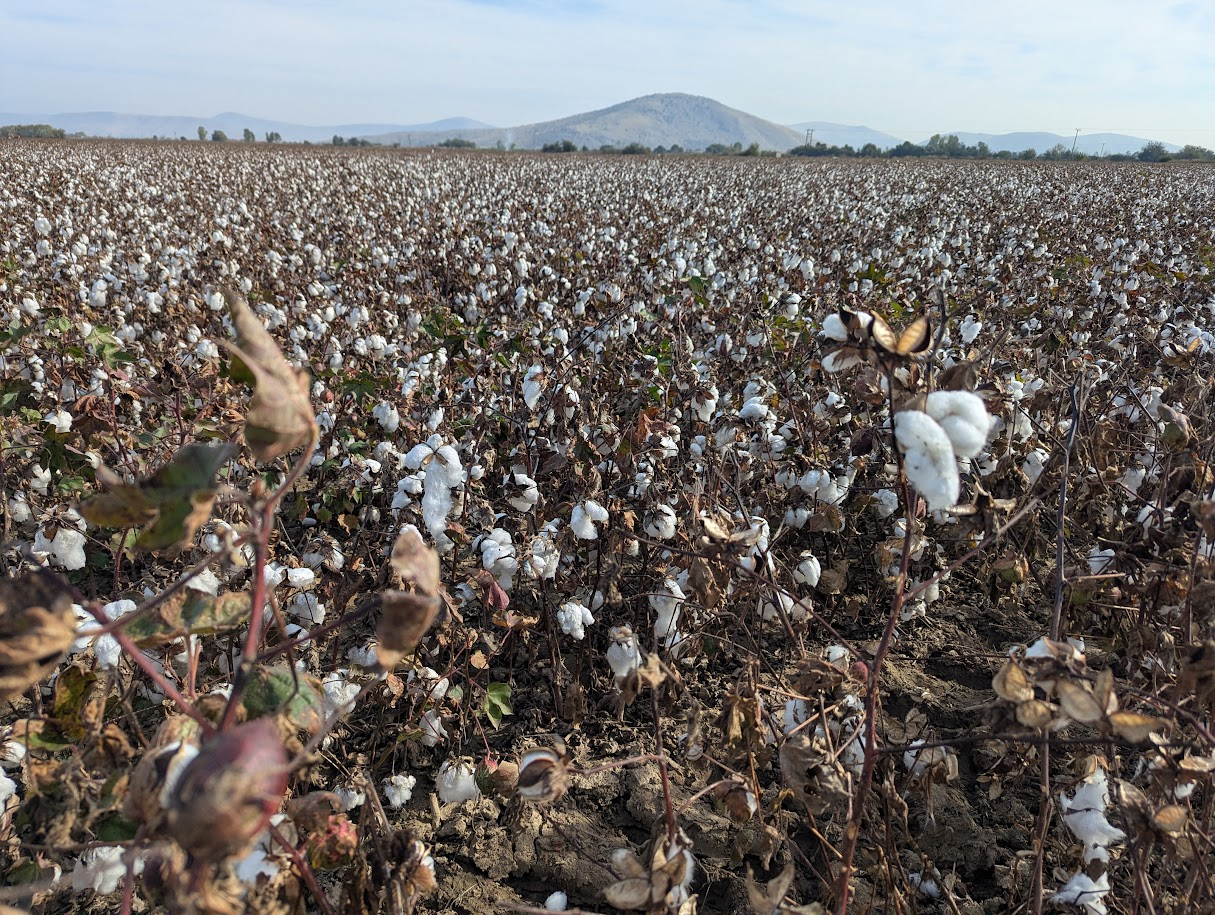
Cotton field in Karditsa, Central Greece
Testing two harvesting pathways
The trial began with coordinated field operations led by CERTH in collaboration with the Nea Enosi Cooperative and the Energy Community of Karditsa (ESEK). Using specialised machinery, the team conducted systematic harvesting of cotton stalks immediately after the cotton-picking season. The first pathway used a forage harvester working in line with a truck, shredding and loading residues directly for rapid transport to the storage site. This method demonstrated high operational efficiency, combining fast performance with minimal manual handling, resulting in an approach with strong potential for large-scale mobilisation of cotton residues. The second pathway assessed a baling system in which the stalks were cut, raked, formed into bales and then transported. During both methods, CERTH collected data on harvesting performance and logistical aspects, such as operation speed, turning times, delays and fuel consumption, to support the comparison between the methods and the development of supply chain simulations.
In parallel, CERTH carried out remote sensing activities to estimate biomass availability. A drone equipped with RGB and multispectral sensors completed three targeted flights over a selected cotton field: before picking, immediately after picking and after residue removal. The multispectral data were processed to generate elevation models and vegetation indices, enabling precise characterisation of crop structure, canopy health and spatial variability.
Early findings and practical challenges
Early findings show that the forage harvester pathway provides a clear advantage in speed and immediate processing readiness, while the baling pathway offers greater logistical flexibility and decentralised storage options. Differences in moisture content, uniformity and particle size between the two methods were found to influence pelletisation performance. Challenges encountered included variable field conditions, differences in stalk density and the need to fine-tune machinery to minimise harvesting losses. Overall, testing both pathways delivered valuable comparative insights that will guide the development of practical harvesting solutions for farmers and cooperatives.
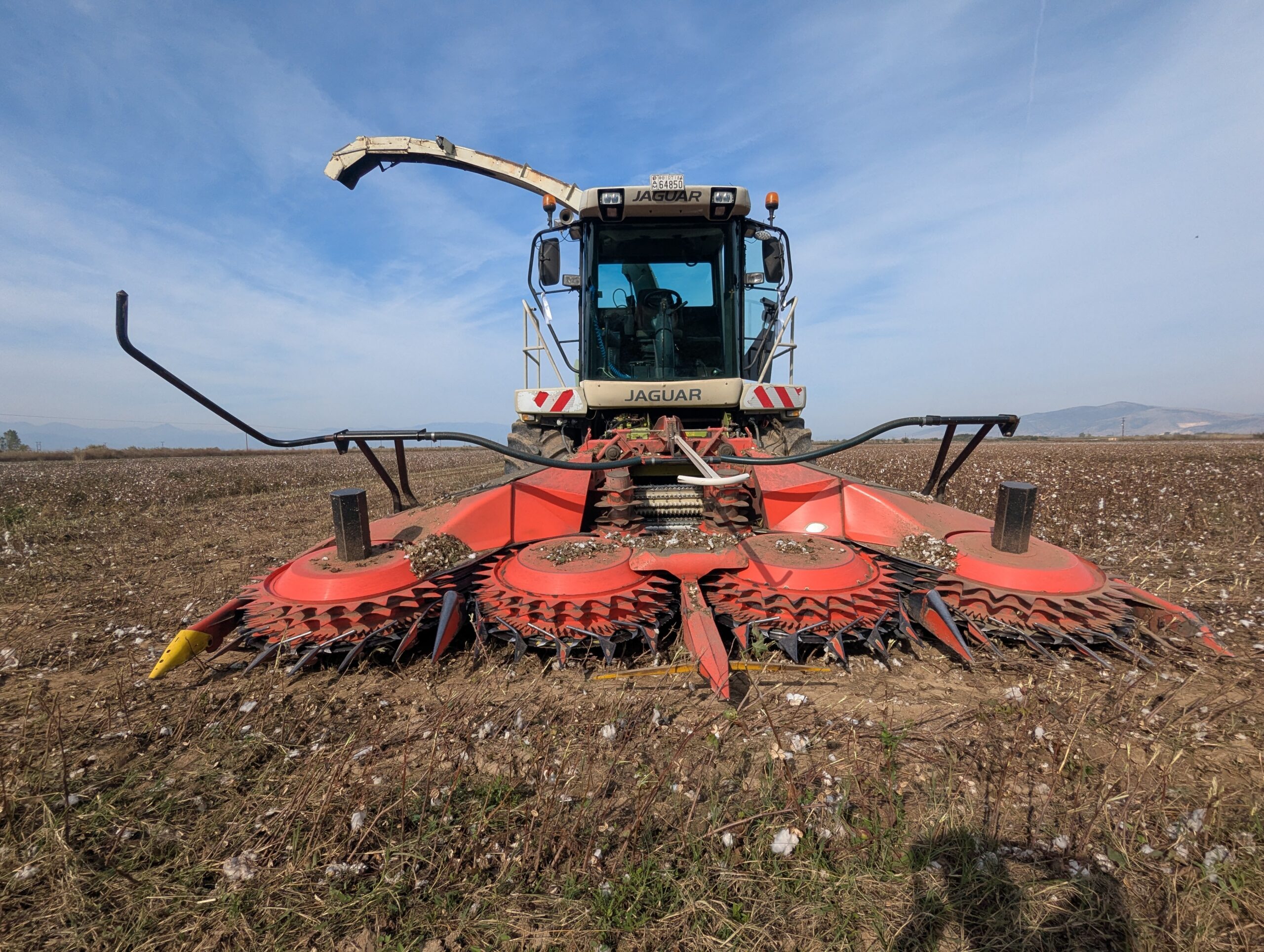
Forage harvester used for cotton residues, Karditsa, Greece
What comes next
The next phase of the Greek pilot will compare storage performance of shredded and baled residues to understand how storage conditions affect fuel properties. The harvested material will also be used across PRIMARY’s value chains, including pelletisation, gasification, biochar production, particleboard densification and soil amendment trials. Additional field measurements and stakeholder consultations will help refine the cotton residue value chain, ensuring it meets the needs of farmers, cooperatives and local communities. Insights will also be shared during upcoming co-creation workshops in Karditsa, where local actors will explore pathways for large-scale adoption.
Join the journey
The field trials performed in Karditsa, Central Greece show that cotton residues have real potential to become a valuable resource for rural communities. PRIMARY invites stakeholders across Europe to follow the progress and join us in developing innovative and sustainable biomass value chains.
Authors:
CERTH, NEA ENOSI, ESEK